Swedish m/1791 Hussar Trooper's Sword
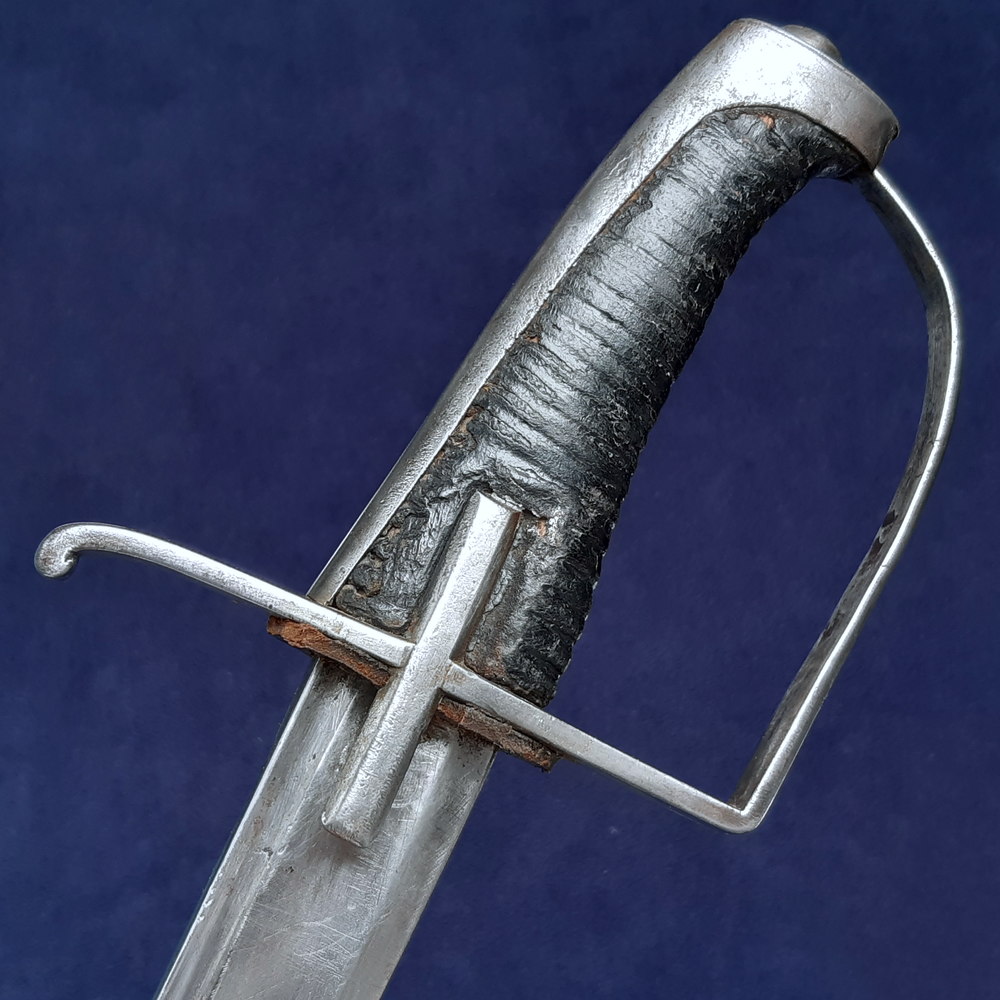


Curved blade with double fullers, one narrow and one broad ‘a la Montmorency’, double-edged at the point. Plain regulation stirrup hilt with faceted rectangular langets, quillon, bevelled knuckle-guard, and one-piece backstrap with slightly beaked pommel cap. Grip of pressed leather over cord-bound wood. Leather washer. Steel wood-lined scabbard in two sections, exposed wood section between them painted black, with two hanging rings.
The outside of the hilt is stamped with ‘K.2 : 9IL13 : 384’. The upper hanging ring swivel of the scabbard is stamped ‘IL13 : 384’, indicating a matching pair. I am not certain of these markings’ significance.
Sweden’s first corps of hussars was created in 1757 at the outset of the Seven Years’ War, taking inspiration from the Hungarian Hussars, which served as auxiliaries to the Prussian army of the time. These Hungarians were considered the best light cavalrymen in Europe and their equipment, dress and tactics were hugely influential. One of the first Swedish Hussars, enlisting in 1758 at the age of 16, was Gebhard Leberecht von Blücher, who was captured by the Prussians in 1760, switched sides to join their Belling Hussars and became the most capable and highly-decorated commander in Prussian history.
A sabre for the Swedish Hussar regiments was officially approved in 1759, essentially a copy of the successful Prussian Model 1742 (which also inspired the British 1788 Pattern Light Cavalry sword). The m/1759 was in due course replaced by the m/1791, which deviated slightly from the Prussian format with a simpler scabbard and square rather than tapering langets.
The m/1791 would have been carried by Hussar units into the Napoleonic Wars when Sweden joined the Third Coalition against France in 1805. Their army fought in Hanover and Swedish Pomerania, notably including the Great Sortie of Stralsund, in the aftermath of which the Swedish hussars distinguished themselves in cutting off retreating French forces: a mere 4 hussars successfully captured 104 French soldiers on the road to Neukalen, while 42 hussars under Bror Cederström secured both a French baggage train and 209 soldiers from the 72nd Infantry. Swedish forces were driven out of Pomerania back to Sweden in September of 1807. At this time the m/1791 was replaced in some regiments by the new m/1807 sabre, while others appear to have retained it until the introduction of the m/1814 or the m/1825 sabres.
The blade has a number of nicks to its edge and a rounded tip, which appears to have broken and been reshaped. The grip is in very good condition for its age, but there are some small losses to the leather at its edges. Some surface flaking to the paint on the leather-faced section of the scabbard. The scabbard’s metal sections have numerous small bumps and dents, which do not interfere with sheathing and drawing. The leather washer has quite roughly cut edges – this may be a replacement.